
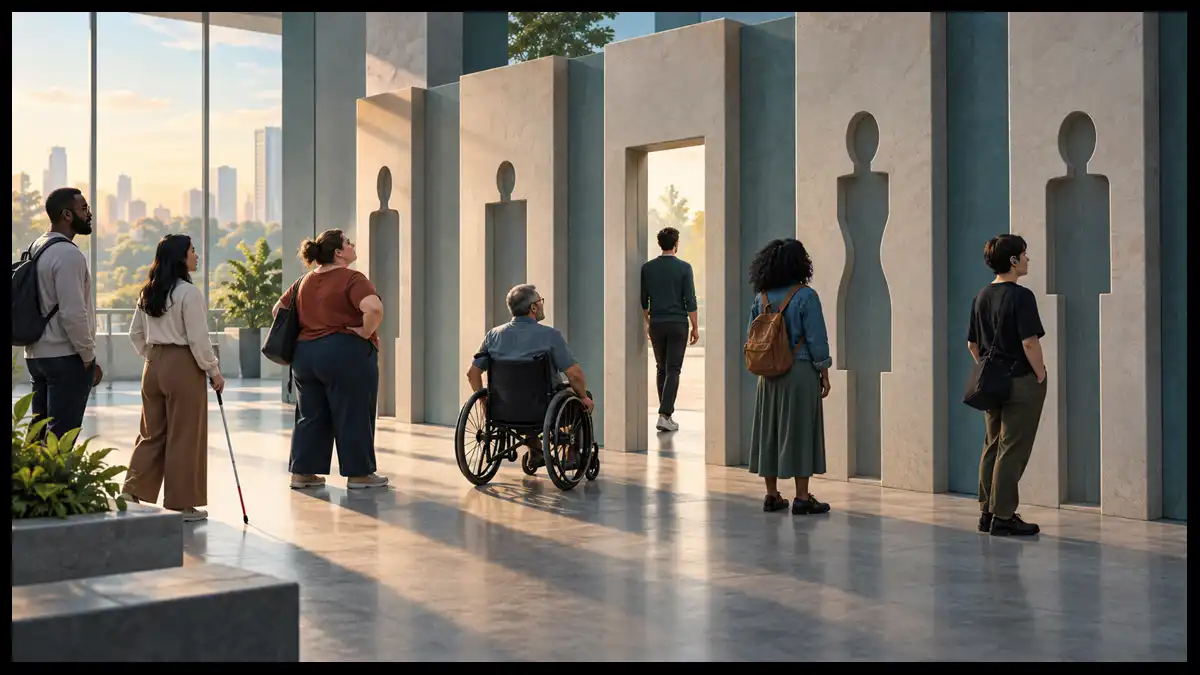
Many environments appear neutral because the people they fit do not have to notice the fit. A staircase seems ordinary until someone needs a ramp. A rapid meeting seems efficient until a participant needs more processing time. A policy that rewards perfect attendance seems fair until chronic illness makes consistency unpredictable. In each case, the standard can disappear into the background while the person who cannot meet it becomes highly visible.
Ableism helps explain this reversal. It is often described as prejudice or discrimination against disabled people, but it also operates through the standards built into places, routines, institutions, and ideas about a worthy life. Independence, speed, productivity, emotional steadiness, conventional communication, and bodily control can become silent entry requirements for being regarded as competent, credible, or welcome (Campbell, 2009; Dolmage, 2017).
This does not mean that pain, impairment, fatigue, illness, or support needs are imaginary products of society. Bodies and minds place real limits on what people can do, and those limits differ from person to person. The more careful claim is that social arrangements can reduce, ignore, or intensify those difficulties. A useful question therefore follows us through this discussion: What abilities does this environment quietly require before a person is treated as competent, credible, or welcome?
Key Definition:
Ableism is a pattern of beliefs, interactions, policies, and designs that treats certain bodies and minds as the standard and disadvantages people whose abilities, health, communication, or support needs fall outside that standard. It may appear as prejudice, paternalism, exclusion, or barriers built into ordinary systems (Campbell, 2009; Shivers et al., 2026).
Table of Contents
- What Ableism Means in Everyday Life
- The Abilities Society Quietly Rewards
- How Ableism Appears in Everyday Life
- Context, Identity, and Resistance
- How Structural Ableism Becomes Institutional
- How Ableism Reinforces Itself
- Psychological and Health Effects of Ableism
- From Awareness to Access
- A Few Words by Psychology Fanatic
- Associated Concepts
- References
What Ableism Means in Everyday Life
Prejudice, discrimination, and exclusion
At the interpersonal level, ableism may appear as ridicule, disbelief, patronizing help, unwanted pity, exclusion, or the assumption that disability says something decisive about intelligence or character. It can be blunt, as when someone is denied an opportunity because of a diagnosis. It can also be wrapped in apparent kindness, as when another person takes control without asking what assistance is wanted.
These encounters matter because they narrow social participation and communicate who is expected to belong. Yet an exclusively interpersonal definition is incomplete. If attention remains fixed on offensive remarks or individual attitudes, a polite organization may appear inclusive while its buildings, schedules, technologies, and evaluation systems continue to exclude.
A system that produces ‘normal ability’
Fiona Kumari Campbell (2009) argues that ableism does more than express dislike of disabled people. It establishes a preferred picture of how a capable body and mind should work, then treats that picture as normal. People who fit it move through systems with little explanation. Others may have to adapt, disclose private information, gather documentation, or request an exception.
The standard changes with context. Reading small print, standing for a shift, sustaining eye contact, navigating sensory intensity, remembering complex instructions, or working at a fixed pace are not universally necessary abilities. They become decisive when an environment treats one way of functioning as the natural way. Ableism is therefore both an attitude toward disabled people and a way of organizing participation.
Disability as an interaction between person and environment
A relational understanding of disability avoids two common errors. One is to treat disability only as an individual defect. The other is to imply that bodies, pain, illness, fatigue, or support needs would disappear if society were redesigned. Disability can involve real embodied limits while also being intensified or eased by surroundings, expectations, and resources.
This person-in-environment perspective matters because capacity is always expressed in a setting. A person may participate fully in one environment and encounter disabling barriers in another. The question is not only what a person can do in the abstract, but whether the setting supplies access, time, tools, support, and respect (Dirth & Branscombe, 2018; World Health Organization, 2022).
The Abilities Society Quietly Rewards
Independence and self-sufficiency
Modern cultures often celebrate the self-sufficient person who needs little from anyone else. Assistance can then be interpreted as dependence, and dependence as failure. But no one is truly independent. People rely on roads, communication systems, accumulated knowledge, paid labor, family networks, and countless forms of care. Some dependencies are simply normalized so thoroughly that they no longer look like support.
Ableism makes certain forms of interdependence visible and shameful while leaving others unnamed. A mobility aid may be treated as evidence of weakness, while a car, an elevator, or corrective lenses are treated as ordinary tools. The distinction says less about whether support is being used than about whose support society has chosen to normalize.
Productivity, speed, and consistency
Workplaces and schools frequently value speed, endurance, immediate responsiveness, and predictable output. These qualities can be useful, but problems arise when they become moral measures. A person who needs rest, flexibility, extra time, or a different communication method may be seen as uncommitted rather than as someone working under a design that assumes stable capacity.
Accounts of ableism in academia show how expectations of constant productivity can pressure people with chronic illness and nonvisible disabilities to conceal their needs or work beyond sustainable limits (Brown & Leigh, 2020). The same logic appears elsewhere whenever a narrow performance pattern is confused with effort, seriousness, or worth.
A hierarchy of bodies and minds
Once one form of functioning becomes the ideal, differences can be arranged into a hierarchy. Speech may be valued over other communication. Emotional control may be valued over visible distress. Some disabilities may be treated as more legitimate than others, especially when they are visible, stable, and easily documented. The hierarchy affects who is believed, who is protected, and who must repeatedly prove that a need is real.
How Ableism Appears in Everyday Life
Hostile, paternalistic, and inspirational ableism
Some ableism is openly hostile: ridicule, harassment, dehumanization, or resentment toward people thought to receive unfair advantages. Other forms arrive as concern. Paternalistic ableism includes unwanted help, infantilization, pity, overprotection, and decisions made for someone without asking. Inspirational ableism turns a disabled person into evidence of courage simply for doing something ordinary. Ableism can also be ambivalent, combining apparent care with envy or resentment. The tones differ, but each can replace a whole person with a familiar social role. Some of these encounters overlap with disability-related microaggressions, especially when a slight communicates inferiority or exclusion.
Nario-Redmond, Kemerling, and Silverman (2019) identified these patterns in open-ended accounts from 185 disabled adults. Their exploratory study cannot tell us how common each form is in the wider population, but it clarifies why apparently benevolent treatment can still diminish autonomy. Respectful support asks what assistance is wanted, accepts that help may be declined, and does not demand gratitude for access that should have been available from the beginning.
Language and credibility
Language does not merely describe disability; it also communicates what a culture treats as desirable, credible, or fully human. Casual metaphors and labels may use disability as shorthand for incompetence, irrationality, or moral failure. Labels can shape expectations and opportunity when they become shorthand for the whole person.
There is no single terminology rule that fits every person. Some prefer identity-first language such as ‘disabled person,’ often to name disability as a social and political identity. Others prefer person-first language or a condition-specific term. The respectful practice is not to enforce one universal formula but to follow the language people use for themselves and to avoid language that turns disability into insult. Guidance developed for autism researchers similarly emphasizes precise, respectful language and attention to community preferences (Bottema-Beutel et al., 2021).
Nonvisible and fluctuating disabilities
When disability is not immediately visible, a person may face a painful choice. Disclosure can invite disbelief, stigma, or lost opportunity; nondisclosure can leave necessary support unavailable. In the exploratory accounts reported by Nario-Redmond and colleagues (2019), people with less apparent disabilities more often described invalidation, accusations of fraud, and resentment about perceived privileges. Fluctuating conditions create another credibility trap: someone who can complete a task on Tuesday may be judged deceptive when the same task is impossible on Friday.
Context, Identity, and Resistance
How intersectionality changes ableism
There is no single experience of disability. Race, gender, class, sexuality, age, migration status, geography, and other social positions affect which differences are noticed, how they are interpreted, and what resources are available. The same behavior may be read differently depending on whose body performs it. A formal accommodation may exist while cost, safety, transportation, racism, gendered expectations, or insecure employment still makes it unusable.
More and colleagues (2026) use feminist group-based inquiry to map how ableism is shaped through intersecting relations of power and how people survive and disrupt it through community, creativity, and collective knowledge. Their work resists treating intersectionality as a checklist. Context changes both the form of ableism and the possibilities for responding to it.
Disability identity, community, and joy
A focus on barriers can accidentally portray disabled people only as recipients of harm. Disability may also be a social identity, a source of community, and a basis for knowledge and collective action. Dirth and Branscombe (2018) review evidence suggesting that identifying with disability communities and developing disability pride can support well-being and help some people interpret stigma as a social problem rather than a personal failure.
Identity is not a requirement, and no one must feel pride in pain, illness, or limitation. People vary in whether disability is central, occasional, unwanted, affirming, or described in some other way. The point is to leave room for more than tragedy and adjustment: disabled people also create culture, pleasure, solidarity, strategy, and political change.
How Structural Ableism Becomes Institutional
Steep steps and repeated retrofits
Jay Dolmage (2017) uses the image of the ‘steep steps’ to describe more than an inaccessible entrance. The steps also represent an institution built around an imagined user: someone who moves, communicates, learns, and performs in expected ways. Access is added later as a special route, often requiring advance notice and personal disclosure.
The retrofit can be necessary, but a culture of repeated retrofitting keeps the original standard intact. Each disabled person must negotiate an individual exception to a design that predictably excludes. Universal design asks an earlier question: How can a place, process, or resource support human variation from the start? It does not eliminate every need for individualized accommodation, but it can reduce the number of barriers people must repeatedly contest.
Ableism in health care
Health care is not outside these dynamics. Facilities, communication methods, diagnostic assumptions, time pressures, and employment practices can all create disability-related barriers. The World Health Organization (2022) emphasizes that health inequities among persons with disabilities arise through interacting structural, social, and health-system factors; disability alone does not explain them.
Research after critical illness offers a focused illustration. In interviews with survivors, families, clinicians, and administrators within one health system, Scheunemann and colleagues (2025) identified experiences such as infantilization, denial of disability, exclusion from decisions, and assumptions that disability meant inability. Iezzoni (2024) likewise describes ableism in health care workplaces, including pressures surrounding disclosure and accommodation. These studies do not establish that every encounter is ableist, but they show how clinical knowledge can coexist with narrow assumptions about disabled lives and workers.
How Ableism Reinforces Itself
The hidden work of disability
Exclusion is not the only cost of ableism. Disabled people may also have to perform extra labor simply to enter and remain in ordinary settings. This can include researching access, arranging transportation, requesting accommodations, collecting documentation, anticipating sensory or energy demands, educating others, deciding how much to disclose, and repairing the consequences when a promised support fails.
Shivers, Sommer, and Shea (2026) found that experienced ableism involved two recurring burdens: being excluded and having to do extra work simply to participate. That work can include locating accessible services, explaining needs, gathering proof, and fixing problems when support fails. Each demand may look small to an institution, but repeated demands consume time, money, attention, and energy.
When exclusion is mistaken for incapacity
Ableism can become self-reinforcing. An environment is designed around an assumed body, mind, schedule, and communication style. The resulting friction creates extra work or blocks participation. Observers then treat reduced participation as evidence of low ability, weak motivation, or limited interest. With fewer opportunities to demonstrate competence or influence design, the original arrangement appears justified.
Psychology Fanatic calls this the assumed-user feedback loop. It is an editorial synthesis, not a validated psychological scale or settled causal model. Its value is practical: before concluding that someone cannot succeed, look upstream. Ask what information, tools, time, flexibility, communication options, and decision-making power were available. This does not guarantee success. It makes the judgment more accurate by separating a person’s capacities from the conditions under which those capacities were tested.
Psychological and Health Effects of Ableism
Exclusion and diminished participation
A barrier does more than block a doorway or task. It can shrink a person’s choices about work, education, health care, relationships, recreation, and community life. Repeated exclusion may communicate that participation is conditional – possible only when the person can minimize disability, accept an inferior option, or absorb the cost privately.
The consequences are not identical for everyone, and they cannot be reduced to a single psychological outcome. Still, health and well-being are shaped by access to resources, respectful care, social connection, and meaningful roles. WHO (2022) argues that avoidable and unjust conditions contribute to health inequities experienced by persons with disabilities. The careful emphasis is on contribution: ableism can worsen health and restrict participation without explaining every difference in health.
Vigilance, concealment, and exhaustion
Uncertain access can require continual forecasting. Will the room be usable? Will fatigue be interpreted as laziness? Will disclosure bring support or disbelief? Should a person correct a patronizing comment or conserve energy? This vigilance is a rational response to environments in which the cost of misjudging safety or access may be high.
Concealment can sometimes protect privacy or opportunity, but it can also delay support and intensify strain. Internalized ableism adds another layer when social judgments are absorbed as self-judgments: needing help feels shameful, rest feels undeserved, or worth seems tied to approximating an able-bodied ideal (Campbell, 2009; Brown & Leigh, 2020). This is not a personal defect. It is one way external standards can become part of a person’s inner life.
Ableism as chronic social stress
Repeated discrimination, concealment decisions, and anticipation of rejection can operate as chronic social stressors. One bounded example comes from Botha and Frost’s (2020) study of 111 autistic participants: everyday discrimination, internalized stigma, and concealment were associated with poorer mental health even after accounting for general stress. This does not establish the same pattern for every disabled group, nor does it reduce mental health to social treatment alone. It illustrates why the psychological burden of ableism may extend beyond isolated incidents.
From Awareness to Access
Why awareness alone is not enough
Education can change what people consciously say without immediately changing their automatic reactions or everyday habits. In an eight-week school program, Wüthrich and colleagues (2024) found that students reported more positive attitudes toward disabled peers, while the study’s implicit measure did not change. The finding comes from one program and age group, but it shows why awareness should be judged by behavior and access, not agreement alone.
Some awareness exercises can even reproduce the assumptions they aim to challenge. Dirth and Branscombe (2018) note research in which disability simulations increased sympathetic or prosocial responses while also lowering expectations of disabled people’s capabilities. Awareness is most useful when it is guided by disabled people and tied to changes in access, authority, and accountability.
Anticipate variation
Awareness matters most when it changes design. Rather than waiting for a person to encounter a barrier, planners can assume that users will differ in movement, vision, hearing, attention, memory, energy, communication, and sensory processing. Multiple ways to enter, receive information, respond, and participate make access part of the ordinary design rather than a private exception.
Reduce the burden of proof
Some verification may be necessary, but repeated, intrusive, or expensive documentation can become a barrier of its own. Organizations can examine whether every demand for proof serves a real purpose, whether temporary or fluctuating needs can be supported promptly, and whether the person requesting access must repeatedly retell private medical information to unfamiliar decision makers.
Include disabled people in decisions
Consultation is not the same as participation. Disabled people need meaningful influence over the policies, research, services, and environments that affect them. WHO (2022) places meaningful participation among the principles for disability-inclusive action. The practical test is whether input can change priorities, budgets, timelines, and definitions of success – not merely whether feedback was invited.
Measure experience, not only intention
An institution may value inclusion and still produce exclusion. Evaluation should therefore ask what people encounter: who participates, where requests stall, how long accommodations take, what hidden labor is required, and whether people feel safe disclosing needs. Measures such as the Experienced Ableism Scale may contribute to this work, but numbers should complement rather than replace disabled people’s accounts (Shivers et al., 2026).
A practical access review
For personal or organizational reflection, Psychology Fanatic offers the following six-step editorial synthesis. It is not a validated clinical scale or formal organizational model; it is a practical sequence distilled from the sources discussed here:
- Notice the assumed user. Describe the body, mind, schedule, communication style, and resources the current design expects.
- Listen for the barrier. Ask affected people what restricts participation without requiring them to defend their worth.
- Locate the level. Distinguish interpersonal behavior from policy, technology, physical design, and cultural expectations.
- Redesign before adding exceptions. Build more than one usable route wherever possible, while retaining individualized accommodation.
- Share authority and resources. Give disabled participants decision-making power, compensation, time, and accessible ways to contribute.
- Review lived outcomes. Check whether access is timely, dignified, and sustainable, then revise when the experience does not match the intention.
A Few Words by Psychology Fanatic
A wider understanding of human capability
Challenging ableism is sometimes mistaken for denying difficulty or pretending that everyone can do everything. It asks for something more honest. Human capacity is variable, relational, and responsive to conditions. A person may be highly capable in one setting and blocked in another. Support can reveal ability without erasing disability, and limitation does not erase dignity.
A wider understanding of capability also loosens the demand that a life must resemble an ideal of independence, productivity, or bodily control to have value. Achievement matters, but so do connection, pleasure, rest, contribution, care, and belonging. None of these belongs exclusively to people who meet a narrow standard of ability.
Ableism often survives between good intentions and ordinary design. We may sincerely respect disabled people while admiring only the forms of strength that look independent, fast, consistent, and easy to recognize. The response need not be guilt. It can be attention: notice which needs are treated as normal, become less certain that one moment of performance reveals the whole person, ask before helping, and use whatever authority is available to remove a barrier before another person must request an exception.
Shared life still requires expectations. The question is whether a particular expectation is necessary, whom it predictably excludes, and whether another route can preserve the purpose without preserving the barrier. These questions will not make every environment effortless. They can make belonging less conditional and access less dependent on generosity.
Associated Concepts
- Social Categorization: how people sort others into groups, simplifying perception but sometimes supporting stereotypes and bias.
- Social Identity Theory: group memberships shape self-understanding, belonging, and intergroup judgments.
- Social Exclusion: restricted belonging and participation can affect identity, health, and behavior.
- Social Stress Theory: discrimination and chronic social strain can accumulate and affect well-being.
- Neurodivergent Thinking: cognitive differences interact with tasks, environments, and expectations.
- Microaggressions: everyday identity-related slights or exclusions may reinforce devaluation even when intent is ambiguous.
- Labeling Theory: social labels can shape expectations, opportunities, and self-understanding.
References
Botha, Monique; Frost, David M. (2020). Extending the Minority Stress Model to Understand Mental Health Problems Experienced by the Autistic Population. Society and Mental Health, 10, (1), 20–34. DOI: 10.1177/2156869318804297
(Return to Main Text)
Bottema-Beutel, Kristen; Kapp, Steven K.; Lester, Jessica Nina; Sasson, Noah J.; Hand, Brittany N. (2021). Avoiding Ableist Language: Suggestions for Autism Researchers. Autism in Adulthood, 3, (1), 18–29. DOI: 10.1089/aut.2020.0014
(Return to Main Text)
Brown, Nicole; Leigh, Jennifer (Eds.) (2020). Ableism in Academia: Theorising Experiences of Disabilities and Chronic Illnesses in Higher Education. UCL Press. ISBN: 9781787354975
(Return to Main Text)
Campbell, Fiona Kumari (2009). Contours of Ableism: The Production of Disability and Abledness. Palgrave Macmillan. ISBN: 9780230579286
(Return to Main Text)
Dirth, Thomas P.; Branscombe, Nyla R. (2018). The Social Identity Approach to Disability: Bridging Disability Studies and Psychological Science. Psychological Bulletin, 144, (12), 1300–1324. DOI: 10.1037/bul0000156
(Return to Main Text)
Dolmage, Jay Timothy (2017). Academic Ableism: Disability and Higher Education. University of Michigan Press. ISBN: 9780472123414
(Return to Main Text)
Iezzoni, Lisa I. (2024). Ableism and Structural Ableism in Health Care Workplaces. JAMA Network Open, 7, (8), e2430315. DOI: 10.1001/jamanetworkopen.2024.30315
(Return to Main Text)
More, Rahel; Aunos, Marjorie; Egermann, Eva M.; Palacios, Maria R.; Palmer, Ingrid; Krubner, Marlene; Michl, Eva (2026). Mapping Ableism’s Intersectionality: Insights from a Feminist Research Group. Feminist Theory, 1–26. DOI: 10.1177/14647001261435522
(Return to Main Text)
Nario-Redmond, Michelle R.; Kemerling, Alexia A.; Silverman, Arielle (2019). Hostile, Benevolent, and Ambivalent Ableism: Contemporary Manifestations. Journal of Social Issues, 75, (3), 726–756. DOI: 10.1111/josi.12337
(Return to Main Text)
Scheunemann, Leslie P.; Christensen, Janelle; Motter, Erica M.; Kim, S. Peter; Eisenhauer, Peter; Gandhi, Nimit; Tomko, Heather; Potter, Kelly M.; Girard, Timothy D.; Reynolds, Charles F., III; Leland, Natalie E. (2025). Ableism After Critical Illness: A Qualitative Translation of Key Concepts to the Post-ICU Context. Critical Care Medicine, 53, (4), e829–e838. DOI: 10.1097/CCM.0000000000006596
(Return to Main Text)
Shivers, Carolyn M.; Sommer, Nicole; Shea, Emma (2026). Measuring the Impact of Ableism: Development and Validation of the Experienced Ableism Scale. Rehabilitation Counseling Bulletin. Advance online publication. DOI: 10.1177/00343552261468291
(Return to Main Text)
World Health Organization (2022). Global Report on Health Equity for Persons with Disabilities. World Health Organization. Website: World Health Organization publication page
(Return to Main Text)
Wüthrich, Sergej; Sahli Lozano, Caroline; Lüthi, Michelle; Wicki, Matthias (2024). Changing Students’ Explicit and Implicit Attitudes Toward Peers with Disabilities: Effects of a Curriculum-Based Intervention Programme. Social Psychology of Education, 27, (3), 935–953. DOI: 10.1007/s11218-023-09837-4
(Return to Main Text)
Last Updated: October 2, 2026