
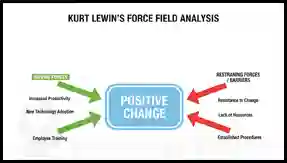
Force Field Analysis: Kurt Lewin’s Tool for Strategic Change
Imagine trying to change a stubborn habit or push a project forward at work, only to feel like you are slamming against a brick wall. We often view these “stuck” moments as static blocks. However, social psychologist Kurt Lewin offered a more dynamic perspective. What looks like an unmovable stalemate is actually a fierce, invisible game of tug-of-war. Lewin described our personal and professional lives not as frozen statues, but as “quasi-stationary processes”—much like a river that appears to hold a steady shape even while water furiously rushes through it.
This is where Force Field Analysis comes in—a diagnostic tool that reveals the hidden armies of “driving forces” pushing for change and “restraining forces” holding the status quo in place. Instead of exhausting yourself by blindly pushing harder against the current, this framework helps you map the battlefield of your “life space.” It identifies exactly where to increase pressure. Often, it is more effective to remove the barriers that keep you locked in position.
Whether you are a manager trying to implement a new system or an individual trying to quit smoking, understanding this hidden “dynamic tension” is the critical first step to unfreezing the present and moving toward your goal.
Key Definition:
Force Field Analysis is a diagnostic tool used to identify the forces for and against a change, developed by Kurt Lewin. By visualizing these “driving” and “restraining” forces, individuals can determine how to shift the balance. This approach helps them achieve their desired goal effectively.
Introduction: Understanding Lewin’s Force Field Analysis
Change is an inevitable aspect of both personal development and organizational growth, yet navigating the complexities that accompany it can often feel overwhelming. In the realm of psychology, Kurt Lewin’s Force Field Analysis emerges as a powerful tool for understanding these dynamics. Developed in the 1940s, this model conceptualizes change not as a static event but as a fluid process influenced by competing forces: “driving forces” that promote change and “restraining forces” that maintain the status quo. By visualizing these opposing elements within our life space, individuals and groups can gain insight into what keeps them stuck. They can learn how to mobilize efforts toward meaningful transformation effectively.
At its core, Force Field Analysis provides a framework for diagnosing challenges whether one is striving to adopt healthier habits or leading teams through organizational shifts. By dissecting the driving forces behind desired changes—such as motivation and support—and recognizing restraining forces like fear or complacency, stakeholders gain insight into their unique situations. This dual perspective equips them with strategies to weaken resistance. It enhances momentum toward goals. This makes it applicable across diverse scenarios. These range from personal aspirations to complex group dynamics.
As we delve deeper into Lewin’s theory of change, we will explore its foundational concepts more thoroughly. We’ll examine key elements such as Life Space—the psychological environment impacting behavior—and the critical steps involved in implementing successful change initiatives through unfreezing existing behaviors before moving toward new ones.
We aim to illuminate Lewin’s contributions to contemporary psychology. We also provide practical applications for those looking to foster positive change in their lives or organizations.
What Is Force Field Analysis?
At its heart, Force Field Analysis is a diagnostic tool used to understand the hidden dynamics of a situation. Rather than looking at a situation (like a workplace routine or a personal habit) as a static “thing,” Kurt Lewin encourages us to see it as a “quasi-stationary process”—more like a river that flows at a specific speed and direction because of the various pressures acting upon it (Lewin, 1951). Lewin described the status quo not as an unmovable object, but as a state of “dynamic tension” where opposing forces happen to be equal (Page, 1977).
To visualize this, imagine you want to implement a new software system. The current way of working is being held in place by two opposing armies. On one side are the “driving forces” (or helping forces) that want to move toward the new goal, such as the promise of efficiency or the excitement of learning (Page, 1977, Vanetzian, 1988). On the other side are “restraining forces” (or hindering forces) pushing back, such as the difficulty of learning a new skill or the comfort of the old routine (Page, 1977, Lewin, 1951).
Harriet Lerner, a highly respected clinical psychologist, adds clarity to this concept by explaining the restraining force of fear in the process of change. She wrote:
“Two things will never change: the will to change and the fear of change. Both are essential to our well-being and to the preservation of our relationships. We all move back and forth between our desire to learn, risk, experiment, and grow—and our anxiety about doing so. Change brings loss in its wake, even when it’s a change we truly and deeply want to make” (Lerner, 2005).
Successful change isn’t just about wishing for a new outcome; it requires a searching diagnosis of this field to see exactly what is keeping these forces in balance (Page, 1977).
The Map and the Engine: Lewin’s Life Space
To truly understand Force Field Analysis, we must look at the “map” it takes place on, which Lewin called the Life Space. He argued that behavior (B) is a function of both your personality and your environment interacting together (B=f(PE)). It is not just a result of your personality or your environment alone. The Life Space represents the “totality of facts” that determine your behavior at any given moment (Lewin, 1936).
Herbert S. Strean explains that the life space is the whole of psychological reality. It consists of “the totality of facts that are capable of determining the behavior of an individual. It includes everything that has to be known in order to understand the concrete behavior of an individual human being in a given psychological environment at a given time” (Strean, 1975, p. 140).
This psychological map includes not just physical objects, but also “quasi-social” and “quasi-conceptual” facts; essentially, anything that has an effect on you—whether it is a physical wall, a friendship, a belief, or a future goal—is considered “real” and occupies a specific region within your Life Space (Lewin, 1936).
The Dynamic Engine of Force Field Analysis
Force Field Analysis serves as the dynamic engine within this map. Lewin distinguished between topology. It charts the “totality of possible events” and shows the layout of where you could go. He also distinguished between vectors (forces). These determine what actually happens (Lewin, 1936).
While the topological map defines the “space of free movement” and the boundaries you face, it is the analysis of vectors—the driving and restraining forces—that explains the actual movement or “locomotion” toward a goal (Lewin, 1936). Therefore, analyzing forces is not a standalone exercise. It is a specific method. This method predicts which of the many possibilities within your Life Space will actually become reality.
Driving Forces vs. Restraining Forces: The Tug-of-War
Lewin’s framework helps us break down the “tug-of-war” that keeps our lives or organizations stuck in place.
- Driving Forces: These are the forces pushing for change or movement toward a goal (Lewin, 1951). They initiate and maintain the momentum for the new behavior (Vanetzian, 1988). While these can be external pressures (like a boss’s orders), they are most powerful when they are “own forces”—fueled by our internal needs and desires (Lewin, 1951). This connects deeply to our need for autonomy. When a goal aligns with our own needs, the driving force is authentic. It is less likely to create inner conflict than a goal “induced” by the power of another. In self-determination theory, this is referred to as intrinsic motivation. Deci and Flaste suggest that intrinsic motivation is at the heart of “healthy behavior and lasting change” (Deci & Flaste, 1996).
- Restraining Forces: These act as barriers. They don’t necessarily drive you backward, but they inhibit movement, much like a physical obstacle or a social taboo (Lewin, 1951; Altman & Taylor, 1973). Examples include fear of failure, lack of time, or social norms that discourage stepping out of line.
The Strategy of Letting Go
In this tug-of-war, if the driving and restraining forces are equal, you stay exactly where you are—in the Status Quo (Page, 1977). To get moving, your instinct might be to pull harder on the driving side (e.g., offer more incentives or apply more pressure). However, Lewin warned that increasing the driving forces often just increases the tension in the system, leading to higher emotionality, fatigue, and aggression (Page, 1977, Lewin, 1951).
Instead, a more effective—and often less stressful—approach is to “let go of the rope” on the other side. By identifying and diminishing the restraining forces, you can remove the barriers. This allows the driving forces that are already there to move you forward naturally. It happens with much less tension.
When restraining forces remain intact, the more we achieve in opposition to those forces, the greater the tension. Maintaining this requires massive amounts of self-restraint, leading to exhaustion and burnout. However, when movement towards an action (or series of actions) is achieved through eliminating or minimizing opposing forces, the changes do not increase tension. Consequently, these changes are more likely to continue.
How Does It Work?
Force field dynamics operate on the principle that a situation is not a static condition, but rather a “quasi-stationary equilibrium”—a dynamic process comparable to a river that maintains a specific direction and velocity due to the various pressures acting upon it (Lewin, 1947).
Within this “social field,” behavior is determined by the totality of coexisting facts. The distribution of forces also determines behavior. These forces generally fall into two opposing categories. There are driving forces that push toward a change or goal. Additionally, restraining forces hinder or oppose that movement (Lewin, 1947). The current status quo exists because these opposing pressures are equal in strength. They are opposite in direction. Essentially, the “resultant force” is zero. This balance holds the behavior or social process at a specific level despite naturally occurring fluctuations (Lewin, 1947, Vanetzian, 1988).
Creating Change by Altering the Equilibrium
To alter this equilibrium and bring about change, the balance of these forces must be disrupted, and Lewin identifies two distinct methods for achieving this (Lewin, 1947). One method is to add or strengthen the driving forces. However, this approach often raises the overall tension in the system. This tension can lead to higher aggression, fatigue, and emotionality (Vanetzian, 1988, Lewin, 1947).
A contrasting and often more effective strategy is to diminish the restraining forces—removing the barriers to change—which allows the system to move to a new level while simultaneously lowering the amount of tension (Vanetzian, 1988, Lewin, 1947). Successful change involves transitioning from the initial level to a desired new level. Then, it involves stabilizing the force field. This ensures the new behavior persists.
“Each factor in the individual’s life space is associated with a force that is as much a part of the factor as any other characteristic.“
~Eleanor Vanetzian (1988)
Changing as Three Steps (CATS)
CATS refers to “Changing as Three Steps,” a model widely attributed to Kurt Lewin that conceptualizes the process of planned change. This framework describes change as a linear progression involving three specific phases:
- Unfreezing the old behavior or situation to create the motivation to change.
- Changing (or moving) to a new level of behavior.
- Refreezing the new behavior to make it permanent.
While CATS is often regarded as the “classic” or “fundamental” paradigm for change management, recent analysis suggests that the model, particularly the specific “refreezing” terminology and its packaging as a tool for change agents, is largely a “post hoc reconstruction” developed by later scholars such as Ronald Lippitt and Edgar Schein. Lewin himself viewed group dynamics not as static states to be frozen, but as continuous fluid processes or “quasi-stationary equilibria” (Cummings et al., 2016).
Unfreeze: Removing the Blockage
While popular management textbooks often present “unfreezing” as the first phase of a rigid three-step checklist, recent analysis suggests that Kurt Lewin never intended this to be a static “ice cube” model, but rather a description of how to disrupt a fluid but stable situation known as “quasi-stationary equilibrium” (Cummings et al., 2016).
Stephen Cummings, Todd Bridgman, and Kenneth G. Brown wrote:
“Lewin never presented CATS in a linear diagrammatic form and he did not list it as bullet points. Lewin was adamant that group dynamics must not be seen in simplistic or static terms and believed that groups were never in a steady state, seeing them instead as being in continuous movement, albeit having periods of relative stability or ‘quasi-stationary equilibria’ (Cummings et al., 2016).
Reality vs. Irreality: The Fluidity of Change
A critical insight for understanding why we get stuck lies in Lewin’s distinction between the level of “reality” (action and hard facts) and the level of “irreality” (wishes, dreams, and plans)(Lewin, 1936). Lewin observed that the “irreal” regions of our life space are much more fluid than the level of reality; in our imaginations, barriers offer almost no resistance, allowing us to “do what we want” and visualize successful change without friction (Lewin, 1936).
However, the level of hard reality is structurally rigid, filled with solid social and physical boundaries that resist movement. The feeling of being blocked often arises when we try to translate a plan from the fluid, frictionless world of irreality into the rigid, resistant world of reality; thus, unfreezing is the necessary process of softening these rigid real-world boundaries to make them as pliable as our plans require (Lewin, 1936, Lewin, 1951).
“The first step, therefore, in attempting to remove the feeling of being blocked, and thereby to assist further progress towards the desired goal, is to carry out a more searching diagnosis of the status quo, specifying as many as possible of the forces involved.”
~Denys Page (1977)
The Dynamic Influence of Social Groups
Lewin viewed social groups not as frozen statues, but as living rivers where the flow is kept steady by an equal balance of driving and restraining forces. “Unfreezing,” therefore, is the necessary psychological process of overcoming the “inner resistance” or “social habit” that keeps a behavior locked at its current level (Cummings et al., 2016). Before any movement toward a new goal can occur, the existing field must be rendered fluid enough to change; simply pushing harder against the status quo without this unfreezing usually results in a return to the previous level once the pressure is removed.
To successfully unfreeze a situation, one must do more than simply present logical arguments; it often requires breaking through the “shell of complacency” and self-righteousness that protects the current way of doing things (Lewin, 1947). Lewin described this as an emotional “stir-up” or catharsis that is necessary to detach individuals from their traditional group standards and prejudices (Lewin, 1947).
Instead of a mechanical tool for managers to impose change, unfreezing is better understood as a complex group dynamic where the validity of the old standard is challenged—often through group decision-making—thereby reducing the restraining forces and allowing the natural driving forces to propel the group to a new level. By focusing on unfreezing as a release of tension rather than an application of force, we avoid the high-stress resistance that occurs when we try to change behavior without first addressing the underlying social habits (Lewin, 1951, Lewin, 1947).
Why Use Force Field Analysis?
The beauty of Lewin’s model is its flexibility; it serves as a “searching diagnosis” for individuals, groups, or organizations who feel “blocked” by seemingly immovable obstacles (Page, 1977). Whether you are managing a team or trying to modify a personal habit, the tool helps you visualize the status quo not as a frozen state, but as a “dynamic tension” between opposing armies of forces (Page, 1977).
This framework fosters thoughtful decision-making by allowing you to break down complex problems into manageable parts—identifying specific “helping” and “hindering” forces—so you can strategically weaken the resistance rather than exhausting yourself by blindly pushing harder against it (Page, 1977). Furthermore, by providing a systematic yet simple way to understand the “total situation,” Force Field Analysis offers a practical roadmap that can renew hope and increase the likelihood of success, even in situations where past attempts to change have failed (Vanetzian, 1988).
“Force field analysis is a method of promoting behavioral change that is systematic, patient-centered, and comprehensive.”
~Eleanor Vanetzian, MS RN (1988)
How to Conduct a Force Field Analysis: A Practical Exercise
To make the most of Kurt Lewin’s theory, try this 5-step exercise for a goal you are currently working on. You can do this on a piece of paper or a whiteboard by drawing a large “T-chart.”
Step 1: Define Your Change
In the center of your page, write down the specific change or goal you want to achieve.
- Example: “Switching to a career in Counseling.”
Step 2: Identify the “Driving Forces”
On the left side of your chart, list all the forces pushing you toward that goal. These are your “engines.”
- Examples: Higher job satisfaction, helping others, better salary potential, personal passion.
Step 3: Identify the “Restraining Forces”
On the right side of your chart, list everything holding you back or maintaining the status quo. These are your “brakes.”
- Examples: Financial risk, the need for more schooling, fear of failure, family time commitments.
Step 4: Score the Forces
Assign a score to each force based on its influence (1 = Weak, 5 = Extremely Strong).
- Does the “Passion” (5) outweigh the “Fear of Failure” (3)?
- Sum up the totals for both sides to see where the balance currently lies.
Step 5: Strategize (The Lewin Secret)
Most people try to succeed by “pushing harder” on the driving forces. However, Lewin discovered that reducing the restraining forces is often more effective.
Ask yourself: * “How can I make the ‘Financial Risk’ smaller?” (e.g., starting part-time)
- “How can I address the ‘Need for Schooling’?” (e.g., finding an online program)
By “letting go of the brakes,” the driving forces you already have can move you forward with much less effort.
The Equilibrium: Why We Stay Stuck in the Status Quo
According to Lewin, what appears to be a stable situation is actually a “quasi-stationary equilibrium,” comparable to a river that maintains a specific course and velocity due to a balance of counteracting pressures (Lewin, 1951, Lewin, 1947, Lewin, 1951a). We often feel “stuck” not because a situation is static or frozen, but because it is held in a state of “dynamic tension” where the driving forces pushing for change are exactly counterbalanced by equal and opposite restraining forces (Page, 1977, Lewin, 1951).
In this state, the “resultant force” is zero, holding the behavior, group productivity, or social habit at a specific level despite the minor fluctuations that naturally occur from day to day (Lewin, 1951).
This stability is often reinforced by what Lewin termed “social habit,” which acts as an “inner resistance” to change. This resistance is frequently rooted in group standards and values; because individuals fear the ridicule or isolation that comes from deviating too far from group norms, they tend to stick close to the established standard.
Consequently, a “central force field” develops around the status quo, where any attempt to move away from the current level triggers stronger opposing forces that push the individual or group back to the original equilibrium. Thus, staying stuck is often an active process of social self-regulation rather than simple inertia.
“To overcome this inner resistance an additional force seems to be required, a force sufficient to ‘break the habit,’ to ‘unfreeze’ the custom.
~Kurt Lewin (1951)
Lewin’s Concept of Barriers and Boundaries
Lewin’s topological psychology provides a rich vocabulary for understanding “Restraining Forces,” describing them not merely as abstract opposition but as barriers with specific dynamic properties, most notably “solidity” (Lewin, 1936).
A barrier is not simply present or absent; it offers varying degrees of resistance, ranging from the negligible effort required for a child to step over the rim of a bathtub to the nearly impassable solidity of a prison wall (Lewin, 1936). Crucially, Lewin notes that this solidity is often relative to the specific type of action being attempted; a barrier might be completely impassable for physical movement—like a prisoner unable to leave their cell—while remaining permeable for “social locomotion,” such as sending a letter or maintaining a mental connection with the outside world.
Furthermore, Lewin encourages us to visualize these obstacles not just as thin lines, but often as deep boundary zones possessing actual “thickness”. While some boundaries are sharp transitions, others act as extensive regions full of “friction,” comparable to a dense physical underbrush that resists movement and requires significant effort to traverse (Lewin, 1936).
When facing a complex change, we are often not crossing a simple line but navigating a “boundary zone” where the friction of the environment actively hinders progress; recognizing whether a barrier is a thin line or a deep zone of friction helps in deciding whether to push harder or to find a different path entirely (Lewin, 1936).
A Few Words by Psychology Fanatic
In conclusion, Kurt Lewin’s Force Field Analysis serves as a pivotal tool for understanding the dynamics of change within various contexts, whether in personal development or organizational transformation. By identifying and differentiating between driving and restraining forces, individuals can gain clarity on the factors influencing their desired outcomes. This approach not only highlights the importance of recognizing internal motivations but also emphasizes that effective change is often achieved by addressing barriers rather than solely pushing harder on driving forces.
Ultimately, embracing this methodology fosters a mindset that values thoughtful decision-making and collaboration. As we navigate through constant changes in our lives—be it switching careers or adapting to new routines—applying Lewin’s principles allows us to transform challenges into manageable steps toward growth. Thus, by comprehensively assessing both sides of the force field, we can shift from mere contemplation to actionable strategies that lead us closer to our goals with greater ease and less resistance.
Associated Concepts
- Reciprocal Determination: This is a concept developed by psychologist Albert Bandura, which posits that a person’s behavior both influences and is influenced by personal factors and the social environment. In other words, a person’s actions can impact their environment, which in turn can shape their behavior, creating an ongoing cycle of influence.
- Exposome: This refers to the cumulative measure of environmental influences and associated biological responses throughout the lifespan.
- Homeostasis: This concept refers to the body’s attempt to maintain a stable internal environment. During the resistance stage, the body tries to return to homeostasis despite the ongoing stress.
- Group Relations Theory: This Theory is a psychoanalytic approach that focuses on understanding group dynamics and individual behavior within group contexts.
- Reciprocal Gene-Environment Model: This model explains how genetic and environmental factors interact in a bidirectional, reciprocal manner to influence human development and behavior. This model suggests that individuals with certain genetic predispositions may create or seek out environments that reinforce those genetic tendencies, and vice versa.
- Stages of Change: This refers to a series of stages that individuals may go through when making a significant behavior change.
- Loss Aversion: We tend to overvalue what we already have and fear losing it more than we value potential gains. This means that the perceived risks of change often outweigh the potential benefits, making us resistant to altering our current state.
Last Edited: February 1, 2026
References:
Altman, Irwin; Taylor, Dalmas (1973). Social Penetration: The Development of Interpersonal Relationships. Holt, Rinehart and Winston. APA Record: 1973-28661-000
(Return to Main Text)
Cummings, S., Bridgman, T., & Brown, K. G. (2016). Unfreezing change as three steps: Rethinking Kurt Lewin’s legacy for change management. Human Relations, 69(1), 33-60. DOI: 10.1177/0018726715577707
(Return to Main Text)
Lerner, Harriet (2005). The Dance of Fear: Rising Above Anxiety, Fear, and Shame to Be Your Best and Bravest Self. Perennial Currents; Reprint edition. ISBN-10: 0060081589
Lewin, Kurt (1947). Frontiers in group dynamics: Concept, method and reality in social science; social equilibria and social change. Human Relations, 1(1), 5-41. DOI: 10.1177/001872674700100103
(Return to Main Text)
Spotlight Book:
Lewin, Kurt (1951). Field Theory in Social Science: Selected Theoretical Papers. Harper & Row. ISBN: 9780837172361; APA Record: 1951-06769-000
(Return to Main Text)
Lewin, Kurt (1951a). Resolving Social Conflicts: And, Field Theory in Social Science. American Psychological Association. ISBN-10: 1557984158; DOI: 10.1037/10269-000
(Return to Main Text)
Lewin, Kurt (1936/2015). Principles of Topological Psychology. Martino Fine Books. ISBN-10: 1614277907; DOI: 10.1037/10019-000
(Return to Main Text)
Page, D. (1977). Action planning through force field analysis. Education + Training, 19(10), 298-300. DOI: 10.1108/eb016527
(Return to Main Text)
Strean, Herbert S. (1975). Personality Theory and Social Work Practice. Scarecrow Press. DOI: 10.1093/sw/21.3.249-a
(Return to Main Text)
Vanetzian, Eleanor (1988). Force Field Analysis: A Person‐Centered Approach to Behavioral Change. Rehabilitation Nursing, 13(1). DOI: 10.1002/j.2048-7940.1988.tb01044.x
(Return to Main Text)

Milgram Experiment

Theory of Reasoned Action

Self-Categorization Theory
